Filed, Not Read: What Your Association's Public Accounts Actually Tell You
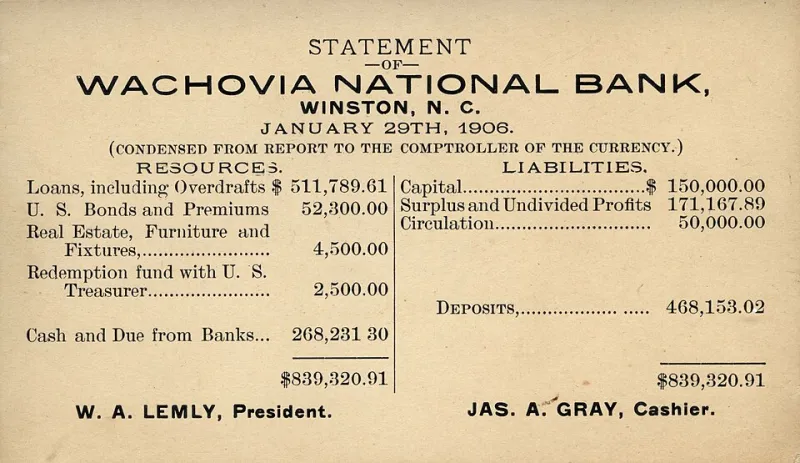
Photo: Wachovia National Bank, Winston, NC, Public domain, via Wikimedia Commons
Somewhere in a filing cabinet at Companies House — or, for the charitably inclined, on the Charity Commission's register — sits the most honest document your association will ever produce. Not the glossy annual review. Not the chief executive's upbeat address at the AGM. The statutory accounts, drafted under legal obligation and filed with little expectation that anyone will ever open them.
That nobody reads them is precisely why they're worth reading. An organisation can curate a newsletter; it cannot curate a balance sheet filed under the Companies Act 2006 or the Charities Act 2011.
Start With the Reserves, Not the Revenue
Members instinctively look at income: subscriptions up, conference revenue up, job done. The more revealing figure sits further down. Reserves policy — how many months of running costs the organisation could survive if subscriptions dried up — tells you whether leadership is stewarding the institution or merely occupying it.
A healthy association might hold six to twelve months of unrestricted operating costs. Watch for the trend rather than the snapshot. Reserves eroding by a few percentage points a year rarely warrants a mention in the chair's foreword, but compounded over a five-year filing history it describes an organisation quietly spending its inheritance.
Note also how the reserves are described. If the free reserves figure is qualified with increasingly creative footnotes — excluding designated funds, excluding the pension deficit, excluding the premises — ask what those exclusions are protecting.
Follow the Related-Party Payments
The notes to the accounts are where disclosure becomes uncomfortable. Related-party transactions — payments to businesses connected with trustees or directors — are legal, common and occasionally entirely proper. A treasurer's own firm providing audit-adjacent consultancy at market rates can be defensible.
What deserves scrutiny is pattern and scale. Payments recurring year after year to the same connected entities, growing without obvious strategic rationale, or appearing without evidence of competitive tender, all suggest a board that has stopped treating its own governance requirements as binding on itself.
Charitable associations must disclose these transactions explicitly. Companies limited by guarantee disclose loans and transactions with directors under the relevant Companies Act provisions. Either way, the absence of any related-party note is itself informative — check the register of interests on the website and see whether the two align.
Read the Governing Documents as a Chronology
Articles of association and governing instruments are filed on amendment. Most members never compare versions, which is a mistake, because the diff between an old version and a new one is a record of what the board wanted to change when it thought no one was watching.
Look for three things. First, alterations to quorum requirements or meeting notice periods — often justified as modernisation, occasionally convenient for a leadership facing a restive membership. Second, changes to the process for removing trustees or officers. Third, any expansion of powers to co-opt members or delegate decision-making away from the general body.
None of these amendments is necessarily sinister. Collectively, they describe the direction of travel — towards accountability or away from it.
The Filing History Is a Character Reference
Companies House makes the full filing history available free. Late filings, accounts filed with qualified auditor's opinions, or a revolving door of company secretaries are all matters of public record. An association that cannot meet a statutory filing deadline is an organisation whose internal processes deserve closer examination before you hand it another year of subscriptions.
For registered charities, the Commission's register adds a governance grade, financial history and any regulatory case reports. A low governance score with no explanation is not a technicality; it is the regulator's considered view.
A Twenty-Minute Discipline
The exercise need not be arduous. Pull the last three years of accounts. Chart the free reserves against annual expenditure. Read every note mentioning trustees or connected parties. Compare the current governing document against the previous filed version. Skim the auditor's report in full — auditors are paid to be dull, so when they use pointed language, it is deliberate.
Twenty minutes, once a year, before renewal falls due. Members routinely conduct less diligence on a £2,000 annual subscription than on a £20 restaurant choice.
The annual report nobody reads is, in the end, a mirror. It shows the association exactly as it is, filed in good order and in plain sight. The only question is whether the membership cares to look.